
Where Packaging Work Shows Up in a Commercial Kitchen
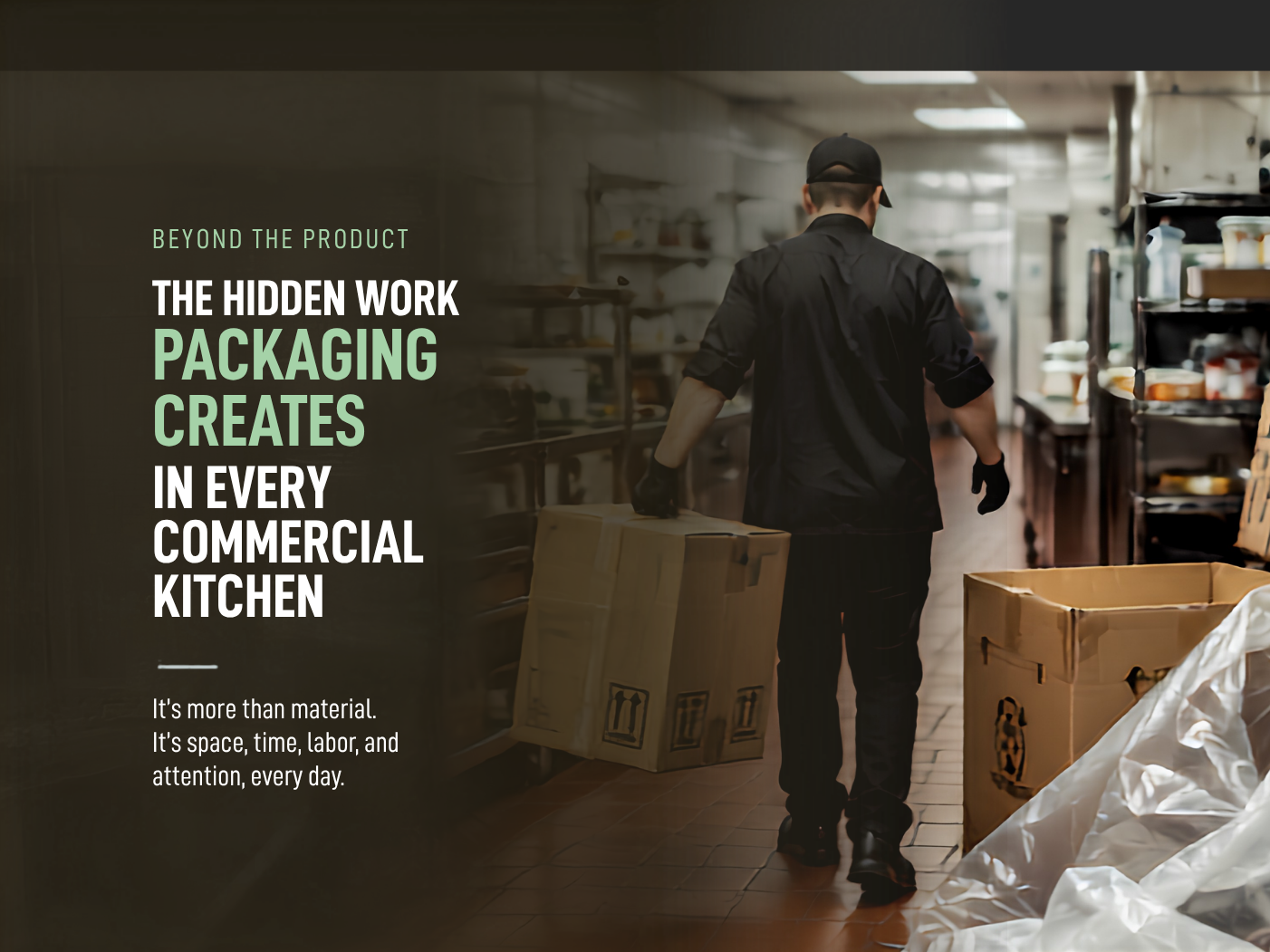
Open a delivery in a commercial kitchen and the work starts before the product is used.
Cases are checked against the order. Containers are moved into storage. Boxes are opened. Inner packaging is removed. Product is carried to where it will be used. Empty containers are set aside, cartons are flattened, and the remaining material is moved toward recycling, recovery, or disposal.
None of this is unusual. That is why it is easy to miss.
The work is spread across the day, divided among different teams, and absorbed into routines already under pressure.
At receiving, packaging shows up as volume.
The supply format determines how many cases, jugs, cartons, caps, liners, and dividers the team has to receive and move. Each action may take only a moment: lift the case, check the count, move it off the dock, find room for it, then do it again.
The number of units matters. More units usually mean more handling, more trips, and more material entering the site with the product.
In storage, the same packaging becomes a space issue.
Commercial kitchens rarely have much room to spare. Shelves, dry rooms, cages, and back of house corridors have to hold product while still allowing people to move safely and work efficiently.
A package that looks manageable on its own can become a different problem when it arrives week after week and competes with everything else for the same limited space.
At the point of use, the work changes again.
Cases are opened. Containers are lifted. Seals and caps are removed. Product is poured, dispensed, or transferred. Staff deal with what remains inside and decide where the empty container goes next.
Cooking oil makes this visible because it is used frequently and often arrives in repeated packaged units. Every case creates several handling steps before the oil reaches the kitchen, and every empty container creates several more after use.
The burden is not only the material. It is the repeated sequence around it.
After use, the package still has to move through the operation.
It may need to be drained, flattened, sorted, staged, stored temporarily, or carried somewhere else in the building. From there, it may be collected for recycling, recovery, hauling, or disposal.
Even when these steps are handled well, they still take time, space, and attention.
The harder part is that no single team usually sees the whole burden.
Receiving sees the volume. Storage sees the space. Kitchen teams see the handling. Waste teams see the material at the end. Procurement sees the purchase. Sustainability sees the diversion or prevention result.
Each function sees one part of the path.
That makes packaging work easy to underestimate. It does not always appear as one large cost or one obvious problem. It is spread across enough people, rooms, and small tasks that no single line item fully captures it.
No single line item will show all of this work. It sits between departments and disappears into the routine.
But when the touchpoints are viewed together, the burden is harder to dismiss. Packaging is not only material that leaves the site. It is a recurring demand on space, movement, time, and labor.
That gives procurement, operations, and sustainability a shared view of what the current supply format is asking the kitchen to carry.
And from there, the work becomes more concrete: identify the unnecessary touches, reduce the material entering the site, and remove the burden where it begins.