
Sustainability conversations often focus on what happens after materials have done their job. Waste is sorted, hauled, diverted, composted, recycled, or sent to landfill. Reporting usually begins there as well, once materials have already entered the waste stream and require some form of handling.
That lens is understandable. Waste is most visible at the back end.
But in many high volume environments, the more consequential decisions are made much earlier. Long before a package reaches a bin or a loading dock, someone has already decided how that product will arrive, what kind of container it will come in, how often it will be delivered, and how much handling it will require once it reaches the site.
In that sense, waste often begins well before disposal. It begins at procurement.
Where Waste Actually Begins
In day to day operations, waste often appears to start where it is collected. It shows up in back of house storage areas, in piles of empty containers, in recycling bins, in trash rooms, and in the steady rhythm of hauling and removal.
But many of those waste streams are shaped much earlier than that.
Procurement decisions determine the format in which products enter a system. They determine whether supplies arrive in disposable units or reusable ones, whether deliveries come with layers of packaging, and whether staff will need to unpack, break down, stack, store, and discard materials every time inventory arrives.
These choices are rarely made with waste as the primary concern. They are usually made around price, supplier relationships, delivery schedules, storage assumptions, and convenience.
Still, the downstream effect is real.
What gets purchased often defines what later becomes waste.
A product may look efficient on a spreadsheet because it has a competitive unit price or a familiar delivery format. But once it enters a high volume operation, that same purchasing decision may bring with it packaging that has to be handled repeatedly, stored temporarily, and removed continuously.
This is one reason waste can be difficult to solve at the back end alone. By the time materials reach disposal, many of the most important decisions have already been made.
When Procurement Becomes Visible
In lower volume settings, these effects may be easy to overlook. A few extra containers, an extra layer of packaging, an additional delivery format, none of it seems especially consequential on its own.
Scale changes that.
In foodservice, healthcare, logistics, manufacturing, and other institutional environments, supply decisions repeat constantly. Packaging formats that appear minor at the item level become highly visible when multiplied across daily deliveries, busy service windows, and long operating cycles.
The result is not only more waste. It is more handling.
Staff spend time unpacking products, breaking down boxes, moving empties out of the way, managing cluttered storage areas, and preparing discarded materials for hauling or pickup. Delivery zones become busier. Storage assumptions begin to matter. Packaging starts affecting workflow.
At a certain scale, procurement decisions do not stay on paper for long.
They show up in receiving areas, back docks, prep spaces, storage rooms, and waste streams. They show up in labor. They show up in operational friction.
This is where procurement becomes visible in a different way. It is no longer just a commercial function tied to sourcing and price. It becomes part of how the site actually works.
Procurement as System Design
Procurement is often discussed in terms of vendor management, contracts, and cost control. Those are, of course, central responsibilities.
But in operational environments, procurement also does something else. It helps define the structure of the system itself.
It determines what materials enter the site and in what form. It influences how frequently deliveries occur, what staff need to handle, what has to be stored, and what must eventually be removed.
In many cases, it shapes the flow of packaging as much as it shapes the flow of product.
That is why procurement can be understood as a design decision, not only a buying decision.
Waste is often managed at the back end, but designed at the front end.
This does not mean procurement teams are responsible for waste in isolation, nor does it suggest that every purchasing decision should be driven primarily by environmental considerations. Cost, reliability, quality, supplier access, and service needs all matter.
But it does mean that sustainability outcomes are often locked in earlier than many organizations assume.
If a system is built around disposable units, repeated packaging, and frequent handling, the waste burden is already part of the model. Recovery and diversion may improve what happens next, but they do not change what was designed to enter the site in the first place.
That is why procurement deserves a more central place in sustainability discussions. Not because it replaces waste management, but because it helps explain where waste begins.
What This Looks Like in Practice
Foodservice is one place where this becomes easy to see.
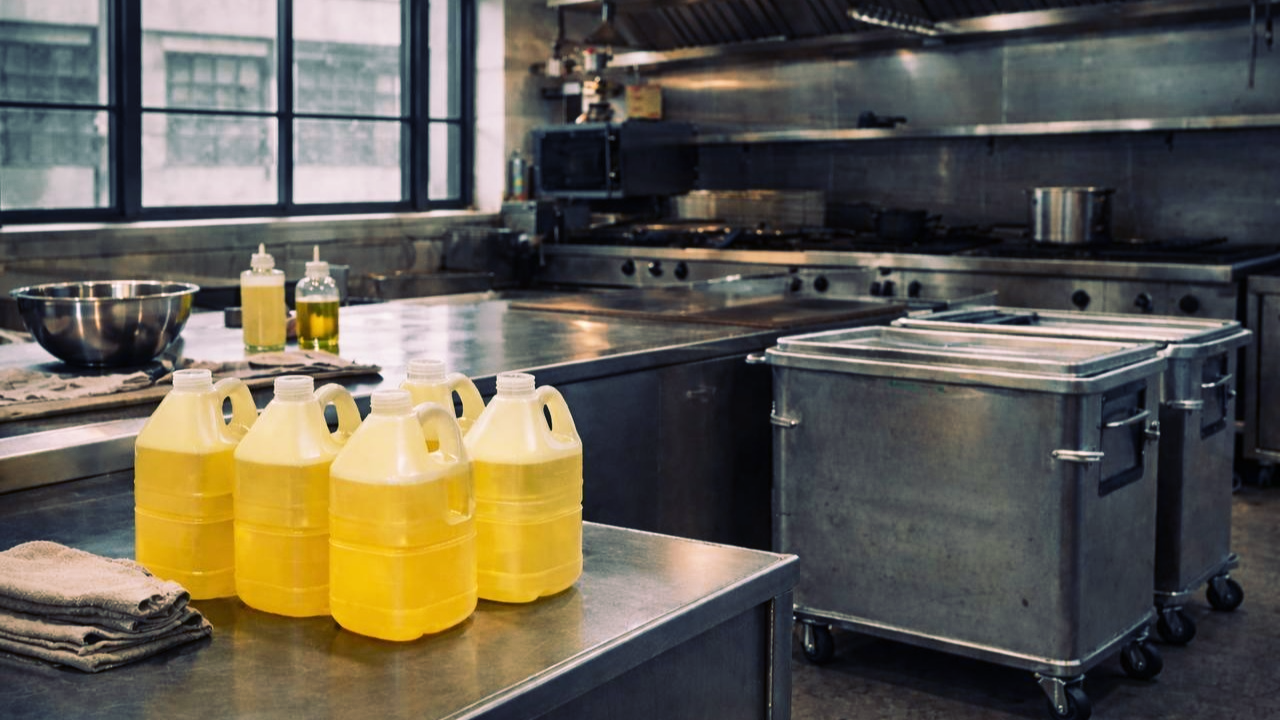
Traditional cooking oil delivery has long relied on disposable plastic jugs. That format is familiar, easy to understand, and widely used. But it is also a procurement decision with operational consequences.
Each delivery brings product into the kitchen along with the packaging that contains it. Those containers have to be received, moved, stored, emptied, and discarded. In a busy kitchen, that cycle repeats again and again. Over time, the waste stream is not incidental to the system. It is built into it.
A refillable delivery model represents a different procurement choice.
Instead of product arriving in disposable jugs, oil is supplied in reusable bulk containers that move through a closed loop return and refill system. The product still needs to reach the kitchen reliably and safely. But far less disposable packaging enters the site with each delivery.
The operational effect is straightforward. There is less packaging to handle, less clutter in storage areas, fewer empty containers to stage and discard, and a clearer reduction in what eventually becomes waste.
Companies like Eco Refill Solutions operate within this kind of model, working with food service teams to replace disposable oil containers with refillable supply infrastructure. The value of that shift is not only environmental. It is also structural. It changes what enters the system in the first place.
This is the larger point. Traditional disposable formats and refillable formats are not simply two packaging options. They are two different system designs with different downstream outcomes.
One builds packaging into the routine flow of supply.
The other removes much of that packaging from the flow altogether.
What Procurement Makes Possible
This dynamic is not limited to foodservice.
Across sectors, more organizations are starting to look at procurement through a wider lens. Unit price still matters, and it always will. But purchasing decisions are also beginning to be examined for the operational patterns they create, the packaging burden they introduce, and the waste consequences they lock in over time.
That shift matters.
Sustainability is not only shaped by what happens after materials become waste. It is increasingly shaped by the upstream decisions that determine what enters the system in the first place.