
Much of the sustainability conversation today focuses on materials. Plastic versus compostable. Recyclable versus biodegradable.
But in high volume operations, another shift is beginning to emerge: redesigning the systems that create the waste in the first place.
A few observations from working closely with large foodservice operations.
That focus reflects a real shift. Waste streams that were once invisible are now measured, reported, and increasingly tied to procurement decisions. Regulatory pressure is rising. ESG reporting has expanded. Organizations are being asked to account for the materials moving through their operations and the waste they generate.
Regulations such as California SB 54 reinforce this shift by placing greater responsibility on producers and supply chains to account for the packaging they introduce into the system.
In many sectors, material substitution has become one of the most visible responses to that pressure. Compostable alternatives, improved recyclability, and new packaging formats are all part of the evolving landscape.
But in operational environments where disposables are consumed in the millions, the question eventually becomes larger than the material.
When Scale Changes the Conversation
Sectors such as healthcare, manufacturing, logistics, and food service operate at a level of volume that changes how waste appears.
Supplies move through these systems constantly. Packaging, containers, and disposable materials accompany almost every delivery. When operations run at high volume, those materials accumulate quickly.
At that scale, waste stops being theoretical. It becomes operational.
Packaging decisions that appear minor at the individual item level can become significant when multiplied across hundreds of locations, thousands of meals, or millions of transactions over the course of a year.
In environments where operational flow matters, waste is not only an environmental concern. It becomes a handling issue, a storage issue, and often a procurement issue.
From Managing Waste to Eliminating It
For many years, sustainability efforts focused largely on what happens after waste is created. Recycling programs, composting infrastructure, and improved disposal pathways were developed to divert materials away from landfill.
Increasingly, organizations are asking a different question: how much of that waste can be eliminated before it appears at all?
In circular economy discussions, this idea is often described as addressing waste upstream. The goal is not only to manage waste responsibly but to redesign systems so certain waste streams never appear in the first place.
One way to think about this shift is through three approaches to waste reduction.
The first focuses on material substitution. Conventional plastics are replaced with compostable or recyclable alternatives.
The second focuses on waste recovery. Recycling systems and composting infrastructure improve how materials are diverted once they have entered the waste stream.
The third looks further upstream at system redesign. Instead of replacing disposable materials with other disposable materials, the supply model itself is reconsidered.
What System Redesign Looks Like in Practice
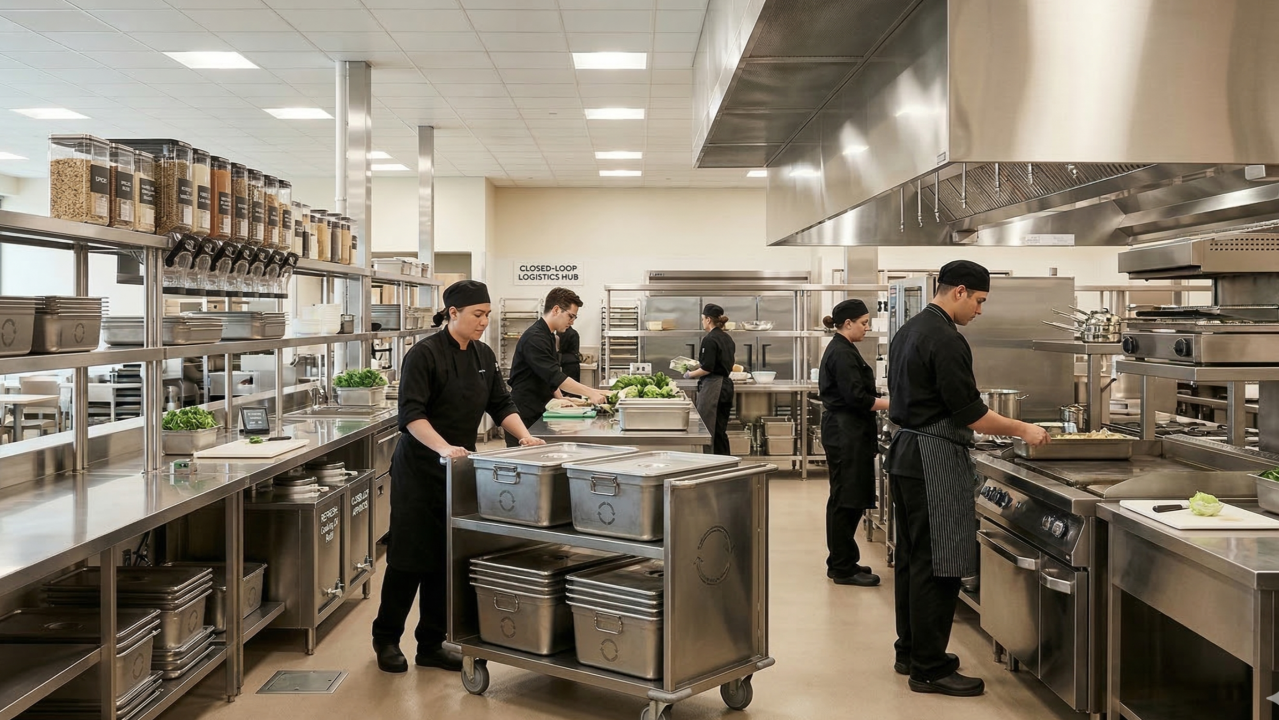
In foodservice operations, one example of this systems approach is the move toward refillable supply models.
Working closely with large foodservice operations, we see how quickly packaging waste accumulates in high volume kitchens. A single site can go through hundreds of oil containers in a year. Across large campuses or multi site food service networks, that number multiplies quickly, turning what might seem like a small packaging choice into a very visible waste stream.
Traditional cooking oil delivery has long relied on disposable plastic jugs. The model is straightforward. Containers arrive filled, they are emptied during kitchen operations, and then they enter the waste stream once discarded.
Refillable systems approach that supply chain differently.
Instead of single use packaging, cooking oil is delivered in reusable bulk containers that remain within a closed loop system. Empty containers are collected, cleaned, refilled, and returned to circulation. The supply continues, but the disposable packaging largely disappears from the process.
The shift may seem simple, but operationally it changes several things at once.
Packaging waste is reduced because the same containers are used repeatedly. Storage areas become less cluttered without stacks of empty jugs waiting to be discarded. Handling time associated with packaging disposal decreases. And because the system is closed loop, the reduction in packaging waste can be measured more clearly.
Companies like Eco Refill Solutions have developed refillable oil delivery systems that operate within this model, working alongside foodservice teams to replace disposable oil containers with reusable supply infrastructure.
Across large campuses, corporate dining programs, and multi site food service networks, systems like these are already operating quietly. Over time they reduce thousands of disposable containers through simple operational redesign.
What makes these systems notable is not only the materials they use, but the supply model itself.