
When I first entered foodservice oil distribution, I did not think I was entering the packaging conversation.
I was thinking about oil.
Quality, sourcing, timing, storage, delivery, kitchen flow, chef expectations, and the discipline required to keep foodservice operations moving without interruption. Before Eco Refill Solutions, I spent more than 17 years with Mediterranean Olive Oil Corporation, providing cooking oil to foodservice distribution, restaurants, and commercial kitchens across the San Francisco Bay Area. That experience taught me to understand oil not only as a product, but as a supply system.
Oil may seem simple from the outside. Inside a working kitchen, it is anything but.
A kitchen cannot wait because a delivery was late. A chef cannot adjust the day because a supply routine was poorly designed. A purchasing team needs consistency. A storage room has limits. Staff already carry enough physical work before anyone adds another box, jug, or disposal step to the day.
Over time, that operating rhythm taught me something I could not unsee.
Packaging was not sitting outside the business of oil. It was inside it.
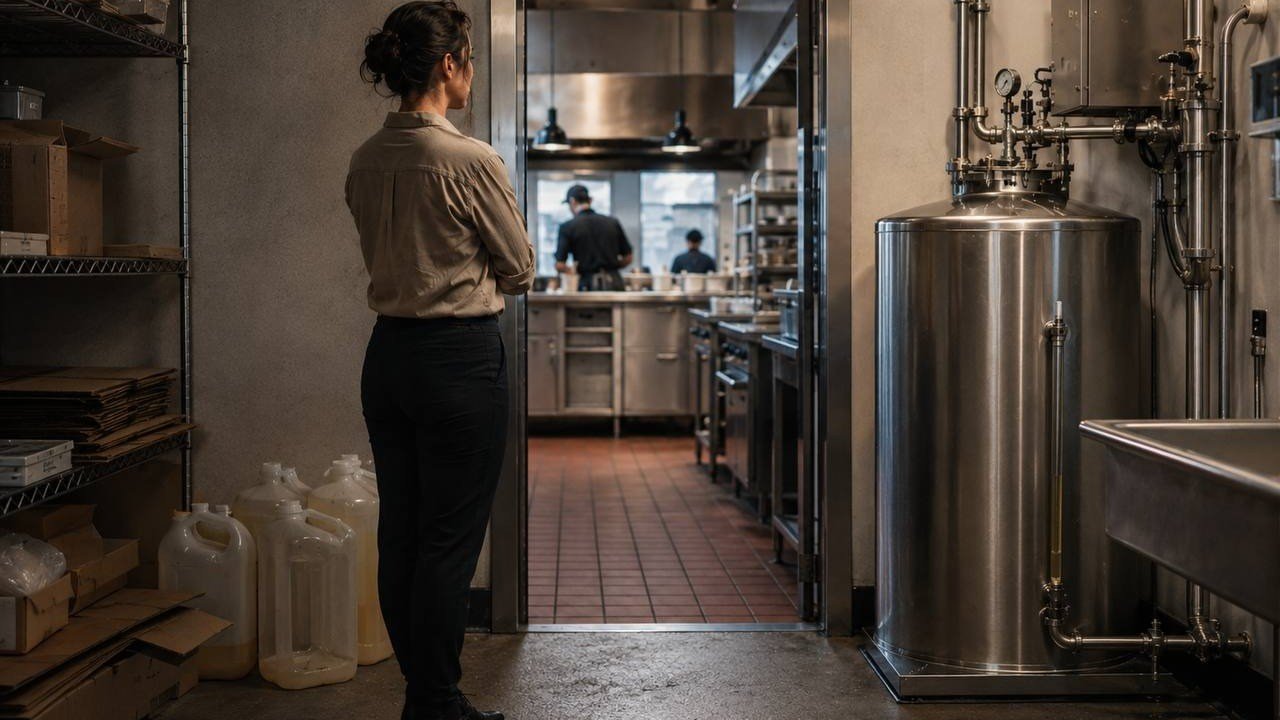
Every jug that arrived had to be received. Every box had to be opened. Every container had to be lifted, stored, emptied, moved, broken down, collected, and eventually hauled away. None of those steps looked dramatic on its own. But foodservice is built on repetition, and repetition is where the real cost often hides.
That was one of the first lessons distribution taught me: packaging is not only a material choice. It is an operating condition.
When a product arrives in single-use packaging, the work does not end at delivery. It simply changes hands. The kitchen receives the oil, but it also receives the packaging burden that comes with it. The storage room absorbs it. Staff handle it. The waste area holds it. Facilities eventually deals with it. Sustainability may measure the disposal, but operations feel the friction long before anything reaches the waste stream.
For years, packaging was treated as something separate from the product. The oil was the purchase. The container was just how it arrived. But after enough time inside high-volume foodservice, that distinction becomes harder to maintain. In practice, the container shapes the work. It affects space, labor, safety, cleanliness, purchasing routines, waste flow, and the number of small touches required to keep a kitchen running.
That is where my thinking began to change.
I did not come to refill by starting with packaging. I came to it by following the work that packaging created.
I started to see that the problem was not simply that foodservice used too much packaging. The deeper problem was that packaging had been accepted as a normal part of how supply works. If oil arrived in jugs, kitchens made room for jugs. If boxes came in every week, teams built labor around receiving, opening, flattening, and removing them. If single-use containers were part of the purchasing routine, their disposal became part of the kitchen routine.
The system had quietly trained everyone to manage the waste instead of questioning why it had to arrive in the first place.
That distinction matters.
A kitchen can improve recycling. It can add better signage. It can sort more carefully. It can look for better materials. All of those efforts may have value. But if the same volume of single-use packaging continues to enter the operation every week, the underlying pattern remains intact. The waste has already been designed into the system before anyone has a chance to manage it responsibly.
Foodservice oil distribution gave me a practical education in this reality. It showed me that meaningful packaging reduction often begins upstream, before the product reaches the kitchen, before staff touch the container, before the disposal question appears.
It begins with how the supply model is designed.
At Eco Refill Solutions, this is the shift we have been building around. We are not trying to make disposable packaging look better. We are trying to remove unnecessary packaging from the routine itself by changing how cooking oil moves into commercial kitchens.
That may sound simple. In practice, it requires a different kind of discipline.
Refill cannot succeed as a gesture. It has to work as infrastructure. It has to be reliable enough for procurement, practical enough for kitchen teams, measurable enough for sustainability leaders, and disciplined enough for daily operations. A refill system that creates more work will not last. A circular model that looks good in a presentation but fails in the storage room will not change behavior. The system has to respect the kitchen.
That respect is central to the work.
Commercial kitchens are fast, physical, space-constrained environments. Any sustainability solution that ignores that reality places the burden on the teams already carrying the operation. I have never believed that real change comes from asking kitchen staff to compensate for poor system design. Real change comes from designing a better routine around them.
This is why I think about packaging differently now.
I no longer see it only as an environmental issue. I see it as a procurement issue, an operations issue, a labor issue, a storage issue, a reporting issue, and a design issue. Packaging is one of the places where all of those systems meet.
When we prevent packaging from entering the kitchen in the first place, we are not only reducing waste. We are reducing the work attached to that waste. We are removing unnecessary touchpoints. We are creating cleaner storage. We are easing disposal pressure. We are giving sustainability teams a more direct way to report prevention, not only diversion. And we are helping organizations see that environmental impact is often built into ordinary operating choices.
That has become one of the clearest lessons of this business for me.
Sustainability is not always found in the dramatic change. Sometimes it is found in the weekly delivery that no longer brings in disposable containers, the storeroom that no longer has to hold empties, the kitchen team that no longer has to manage as many packaging touchpoints, and the procurement decision that prevents waste instead of sending it downstream for someone else to solve.
Foodservice taught me to respect what repeats, because what repeats becomes the system.
If single-use packaging repeats, waste becomes routine. If unnecessary handling repeats, labor absorbs it. If disposal repeats, sustainability becomes a back-end effort. But if refill repeats, prevention becomes part of the operating model. The impact is no longer occasional or symbolic. It is built into the way the product moves.
That is the future I believe foodservice can build toward.
Not perfect kitchens. Not performative sustainability. Not packaging swaps that leave the same burden in place. But better-designed supply systems that make the lower-waste choice practical, measurable, and repeatable.
What foodservice oil distribution taught me about packaging is this: the container is never just the container. It carries a decision, a routine, and the hidden work someone eventually has to do. Once you see that clearly, the question changes.
It is no longer only, “What kind of package should we use?”
It is, “Why does this packaging need to become part of the operation at all?”